
Less than half of all graduates were employed, with 48.8 per cent reporting some form of work.

If one has to compare the tenures of the two prime ministers one must credit Nehru with laying the foundations on which Modi is building a grand edifice, asserts Colonel Anil A Athale (retd).
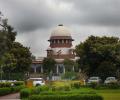
Three academics involved in drafting a controversial NCERT textbook chapter on corruption in the judiciary have approached the Supreme Court to defend their work, stating it was a collective effort and not the view of any single individual.

"Nations need to recognise higher education as the engine of economic growth and prosperity," says Dr Susan Aldridge, president, University of Maryland University College, US, Aziz Haniffa reports

Investors and startup executives are calling for extending the period for an entity to be recognised as a startup from 10 to 15 years for deep-tech companies.

Steps will be taken to attract external commercial borrowing and FDI in the education sector, the finance minister said. Stating that govt will soon introduce new education policy, Sitharaman said online degree courses to students from weaker sections.

Nasscom's newly appointed Chairman, Srikanth Velamakanni, outlines key priorities including restoring revenue growth in IT firms and promoting the role of artificial intelligence and other technologies in companies.

The Supreme Court has stayed a recent University Grants Commission (UGC) regulation following petitions arguing that the Commission's definition of caste-based discrimination was too narrow, excluding certain categories from institutional protection.

'...the enormous responsibility and faith the youth has put on his shoulders, that he is going to solve their problems.'

In a world fractured by uncertainty, India stands out for its policy consistency, paired with sustained ambition, points out Pritam Banerjee.

Addressing a summit in Varanasi on the implementation of the National Education Policy, Modi said the system should not just produce degree-holders but provide human resources needed to take the country forward.

Congress leader Kumari Selja expresses concern over the NCRB report highlighting a surge in crimes against children in Haryana, urging the state government to take immediate action.
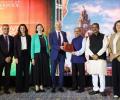
Initially, we will look to take a small batch of a few hundred students, with a plan to increase this to 5,000 students in the next five years, and eventually 10,000 by 2036.'

The Indian government has issued a stern warning to industrial users who are reportedly procuring cheaper retail fuel instead of industrial-grade fuel, leading to significant losses for state-run oil marketing companies (OMCs) and potential local shortages. This diversion, driven by a substantial price difference between retail and bulk diesel, is adversely impacting OMCs, which are absorbing daily losses of approximately 550 crore to keep retail prices stable.
Sitharaman said the government will bring in a new national education policy to transform India's higher education system into one of the best in the world.

A new report indicates a decrease in international student enrolments in US colleges, but India remains the top source of international students.

'India's ties with Israel have to do with defence and general technology.' 'The war changes nothing in what India and Israel hope to get from the relationship.' 'It's not as though India will get significantly more benefits from Iran if India abandons Israel at this time.'

'India cannot speak of a demographic dividend if half its young women are unable to participate in paid work.'

Top female executives are calling for corporate India to redesign workplace systems to support women's advancement into leadership roles in the technology sector, particularly in emerging fields like artificial intelligence.
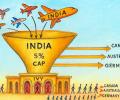
Trump's proposed policy limits undergraduates from any one country to 5% at select top US universities, raising concerns for Indian aspirants eyeing elite colleges.

Uncertainty clouds US fall intake as Trump's visa ban on Harvard raises fears of wider policy shifts, pushing Indian students to explore alternative destinations.

The Supreme Court's stay on the UGC equity regulations aimed at preventing caste-based discrimination on campuses has been met with mixed reactions. Opposition parties welcomed the decision, while some expressed concern over the implications for marginalized communities.

IMF Managing Director Kristalina Georgieva discusses the potential of artificial intelligence to boost global growth, particularly in India, while also addressing the significant risks of job displacement and financial instability.

By giving students powerful tools early, these companies build long-term trust and affinity.

With stricter policies dampening the US/UK dream, Germany, Ireland and New Zealand are emerges as new study abroad destinations for Indian students.

'Our problem is not a budget deficit but a trust deficit. We need to trust our institutions and industries to innovate and lead. That is the way forward for India.'

'The reason why they rushed through the bill was they wanted to avoid using the 2026 Census because the 2026 Census by their own decision will be a caste census.' 'The BJP knows that a significant share of the OBCs who will get captured in the census, for the first time after the 1931 Census, are against the BJP. Only a segment of the OBCs are in their favour.' 'So they wanted to avoid the OBC reservation among women, which is a demand of a lot of Opposition parties.'

Can change happen? Not unless the changemakers themselves want it since they benefit the most from the status quo, warns Biswajit Dasgupta.

Ask rediffGURU Naveenn Kummar your insurance mutual fund and personal finance-related questions.
At the Mumbai campus the institute will offer both UG and graduate degrees, most of its courses will focus on science, technology, engineering and mathematics.

The Supreme Court has ruled that women Short Service Commission officers in the Army, Navy, and Air Force, who were unfairly denied Permanent Commission, are entitled to full pensionary benefits.

While many areas compete for resources, defence, education, and adaptation deserve focus for maximum impact, suggests Laveesh Bhandari.

This was perhaps a missed opportunity for India to spotlight a core domestic challenge: The scale of workforce preparation required for a young, populous, rapidly growing country seeking to reach net zero, points out Radha Roy Biswas.

'Such unpredictability is motivating families to seek destinations with a more stable educational system.'

Capex, infrastructure development, and prudent fiscal management are the key focus areas in the Budget, says Nilesh Shah.

If India, China and the United States are to prosper in a globalised economy, a joint, cooperative transformation of their higher education systems was imperative, believes B M Naik, former principal of the engineering school at the Guru Gobind Singh College in Nanded, Maharashtra."To bring about this transformation from one level to the high level and to the global level and quality standard education, what is most important is that these ideas must move fast," he said.
The guidelines have been prepared in line with the National Education Policy (NEP) 2020 that has envisioned that top universities in the world will be facilitated to operate in India.

"We have to collectively address all doubts. The vision of flexibility with which this policy was brought... We will have to show in a similar way maximum flexibility in implementing it," Modi said while addressing the 'Governors' Conference on the Role of NEP in Transforming Higher Education'.

The Indian government has expressed its disagreement with the IMF staff's 'baseline' assumption that the 50 per cent US tariffs on its goods exports 'would remain in place indefinitely', based on which the staff pegged the country's GDP growth at 6.6 per cent this year, and pared its 2026-27 projection by 20 basis points to 6.2 per cent.

The foreign degree no longer sells itself, families are doing the math, and for many, the numbers just don't add up.
